
Here and Now
Inside Wisconsin Politics: Data Centers in the Governor Race
Clip: Season 2500 Episode 2508 | 5m 23sVideo has Closed Captions
Inside Wisconsin Politics on how data centers are a wedge issue in the governor's race.
Inside Wisconsin Politics reporters Shawn Johnson, Zac Schultz and Anya van Wagtendonk discuss how data centers are a wedge issue in the 2026 governor's race between David Crowley and Tom Tiffany.
Problems playing video? | Closed Captioning Feedback
Problems playing video? | Closed Captioning Feedback
Here and Now is a local public television program presented by PBS Wisconsin
Here and Now
Inside Wisconsin Politics: Data Centers in the Governor Race
Clip: Season 2500 Episode 2508 | 5m 23sVideo has Closed Captions
Inside Wisconsin Politics reporters Shawn Johnson, Zac Schultz and Anya van Wagtendonk discuss how data centers are a wedge issue in the 2026 governor's race between David Crowley and Tom Tiffany.
Problems playing video? | Closed Captioning Feedback
Where to Watch Here and Now
Here and Now is available to stream on pbs.org and the PBS app.
Providing Support for PBS.org
Learn Moreabout PBS online sponsorshipfor having me.
>> Turning to this week's Inside Wisconsin politics.
Our panel of reporters discussed the campaign implications of data centers and how the candidates for governor are treating the brand new wedge issue.
>> As far as wedge issues go, it's fairly clever.
This is a relatively new issue to politics, so it's not defined in the way that some other issues are.
You don't know exactly where the interest groups stand with the parties.
So Ana how is that playing out in this attack from Tom Tiffany?
How is he going after David Crowley trying to frame him?
>> Yeah, I mean, he's trying to use his initials against him.
He's calling him Data Data Center.
David Crowley DC, DC as a way of trying to kind of tie him to this.
And the way he's doing it is in a slightly convoluted way by saying that because David Crowley hasn't pledged to kind of roll back these specific tax incentives, that that makes him more pro data center.
David Crowley is also kind of trying to split the difference a little bit and say, well, I support local control.
So communities that don't want it don't have to have it.
I would want, you know, sort of tight controls and regulations in this kind of thing.
But the other kind of interesting piece of how Tom Tiffany is handling this.
So I went yesterday to an endorsement announcement for these environmental groups that are now backing David Crowley.
And of course, environmental concerns are very tied up in people's concerns over data centers.
And part of the way that that Tom Tiffany is now framing it is that data centers are taking away farmland.
And also because there's a push from Democrats to have sustainable energy, be sort of the backbone of data centers.
He's also now kind of using it as a one, two, three punch of they're trying to take farmland, not just to create data centers, but also to create wind farms and solar farms.
And so he can kind of package it together in all of these things that will speak to Republican voters.
Democrats obviously, like solar, like wind farms.
And so they'll have more of their work cut out for them to kind of distinguish those issues.
seeing some social media appearances from Tom and he's kind of framing it as data centers versus farmland.
It's maybe like a pretty transparent appeal to rural voters in that instance.
>> It's doing so many things at the same time because it is about his base and rural farmland.
One of his earliest ads months ago talked about how to prevent foreign countries from coming in and buying up our farmland, which is an issue that does concern people that are worried about the rising cost of just trying to rent out a field to put crops in the ground, as we've seen with all the international tariffs affecting soybean and corn farmers, they're looking for someone to blame.
And if they're some of the cognitive dissonance for them is they don't want to blame Donald Trump.
I've interviewed them, and they don't really want to blame him and his decisions.
So if they Tom Tiffany says, well, it's not his fault.
It's over here.
This is who you blame for your rising costs.
Well, they're more than happy to follow along if they're if they're in that inclination to begin with.
So it's definitely a way to do that.
But what's another element that's trying to split off those Hong voters from David Crowley and split the left, because we've seen elections where the far left and progressive left have sat out.
Maybe not in huge numbers, but enough numbers where potentially it does swing an election.
We saw that with Hillary Clinton.
We saw that with Kamala Harris, and they're trying to repeat that pattern with David Crowley.
If they can paint him as more moderate, more corporate and less true, far left than some of those voters may go third party or just set out together.
And that's one of the concerns, is he has to watch his flank, even though he won by being in the center.
>> That's definitely an open question for me, especially because you at least get the impression that a lot of Hong voters are maybe not a politics first kind of voter.
You know, they came to her because she spoke to them in different ways, more of a movement candidate.
She would not want to identify with Donald Trump, but a movement candidate in that way.
You get different people into the political arena.
And, you know, one question that I think some of them had during the primary was, why don't more Democrats just say what Francesca Hong is saying?
We're going to have a moratorium on data centers.
I like the sounds of that.
Why wouldn't David Crowley Ana just say, hey, let's let's put the brakes on these.
And this data center issue is all taken care of for me politically.
>> Well, politically speaking, data centers are not popular.
The vast majority of voters, Democrats and Republicans, don't support data centers, or they certainly don't support them sort of coming into their own communities.
But there is a real kind of question around the types of jobs that they can bring in, the kind of economic development possibilities there.
And so I think like as a politician, you don't necessarily want to say, you know, categorically, I will not support a thing that could be a driver of economic growth, especially in some of these kind of hard hit places in Wisconsin that are kind of hurting for economic opportunities.
You know, is that a lot of the the data center, a lot of the unions that Bakke David Crowley are involved in data center construction.
And so one of the things that he has said is that, you know, again, if a local community wants a data center, one of the things that he would want to see is that it has to be union built.
That gets you union support.
And unions are a pretty big part of how the Democratic Party defines itself as being a party of the unions.
And unions are a pretty big part of how Republicans have started to kind of make huge inroads with working people.
So the union question, I think, is an untapped and unanswered one so far.
>> Look for reporting from Murv Seymour on what community members think about data centers.
That's next Friday on this program.
In other state news, the UW In other state news, the UW
 New
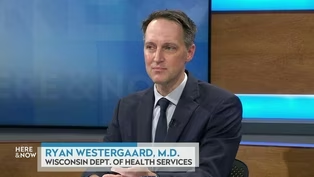
NewDr. Ryan Westergaard on Measles Cases in Southwest Wisconsin
Video has Closed Captions
Clip: S2500 Ep2508 | 5m 44s | Dr. Ryan Westergaard on a measles outbreak and falling childhood vaccination rates. (5m 44s)
 New
NewHere & Now opening for August 21, 2026
Video has Closed Captions
Clip: S2500 Ep2508 | 1m 22s | The introduction to the August 21, 2026 episode of Here & Now. (1m 22s)
 New
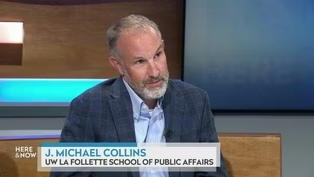
NewJ. Michael Collins on Student Loan Defaults and the Economy
Video has Closed Captions
Clip: S2500 Ep2508 | 5m 35s | J. Michael Collins on the rising number of student loan borrowers who are in default. (5m 35s)
 New
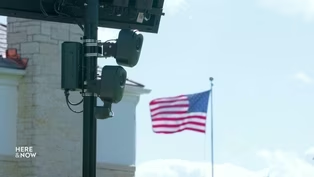
NewThe Rise of and Opposition to Flock Cameras in Wisconsin
Video has Closed Captions
Clip: S2500 Ep2508 | 2m 49s | Widespread automated license plate reader use has provoked a vocal surge of opposition. (2m 49s)
 New
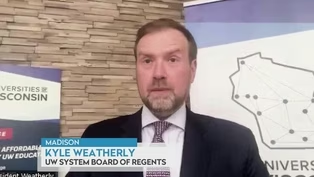
NewUW System Pushes for Tuition Freeze in Return for Investment
Video has Closed Captions
Clip: S2500 Ep2508 | 1m 29s | The UW Board of Regents plans to freeze tuition if the state invests in the system. (1m 29s)
Providing Support for PBS.org
Learn Moreabout PBS online sponsorship New Episode
- News and Public Affairs

Top journalists deliver compelling original analysis of the hour's headlines.
 New Episode
- News and Public Affairs

Today's top journalists discuss Washington's current political events and public affairs.

 New Episode
 New Episode
 New Episode
 New Episode

 New Episode
 New Episode
 New Episode
Support for PBS provided by:
Here and Now is a local public television program presented by PBS Wisconsin