VPM News Focal Point
Relying on science to open minds and create beauty
Clip: Season 2 Episode 10 | 7m 43sVideo has Closed Captions
Art for the Journey has more than a million dollars available to serve more seniors
Gerontologist Dr. Elizabeth Lokon of Ohio created Opening Minds Through Art (OMA) to enrich the lives of older Americans, especially those with cognitive decline. Participant testimonials suggest that neither age nor limited cognition need interfere with artistic creation. Now with a million-dollar grant, the Virginia non-profit Art for the Journey aims to bring the program to thousands more.
Problems playing video? | Closed Captioning Feedback
Problems playing video? | Closed Captioning Feedback
VPM News Focal Point is a local public television program presented by VPM
The Estate of Mrs. Ann Lee Saunders Brown
VPM News Focal Point
Relying on science to open minds and create beauty
Clip: Season 2 Episode 10 | 7m 43sVideo has Closed Captions
Gerontologist Dr. Elizabeth Lokon of Ohio created Opening Minds Through Art (OMA) to enrich the lives of older Americans, especially those with cognitive decline. Participant testimonials suggest that neither age nor limited cognition need interfere with artistic creation. Now with a million-dollar grant, the Virginia non-profit Art for the Journey aims to bring the program to thousands more.
Problems playing video? | Closed Captioning Feedback
How to Watch VPM News Focal Point
VPM News Focal Point is available to stream on pbs.org and the free PBS App, available on iPhone, Apple TV, Android TV, Android smartphones, Amazon Fire TV, Amazon Fire Tablet, Roku, Samsung Smart TV, and Vizio.
Providing Support for PBS.org
Learn Moreabout PBS online sponsorship(indistinct chatter) SALLY GUNN: I mostly do art that is detailed.
Had there been more schools available at the time when I was coming through college, I would've liked to have gone to a school that does medical art.
I love detail.
ANGIE MILES: When they said to you, "Oh, this is going to be abstract art."
What was your response?
SALLY GUNN: ‘I can't do it.
(laughs) But it's funny.
You get this piece of paper in front of you and all of a sudden the blank paper becomes filled with color and a theme.
It just comes.
It's amazing.
So, doing this kind of art was a stretch for me and I've just kind of let everything loose and it feels good.
CINDY PAULLIN: Art for the Journey is a Richmond based nonprofit arts organization, and the mission is to transform lives through art and community.
And Opening Minds through Art or OMA is a program that is developed by a gerontologist in Ohio that we brought to Virginia and deliver to seniors around the region and beyond.
This program is personal to me.
I was my mother's caregiver.
I felt a sense of not being able to help her as she suffered a stroke and eventually Lewy body dementia.
I cared for her in our home and then I cared for her by visiting her in assisted living.
And every time I drove away from her, I cried because I couldn't find a way to save her from this fate.
So years back, in 2015, when I learned about this wonderful opportunity becoming certified in OMA was life-changing for me.
DIANNE SIMONS: OMA restores energy and love and passion and joy and connection.
And there are so many people in nursing homes who need people attention and they need to exercise their creativity, their minds, and their talents and their abilities.
We do something called Inspirations where the artist is shown a couple of examples of the project that's going to be done that day.
And they're intentionally very different; different colors, different designs.
They all end up unique.
But you ask them, ‘Which do you prefer?
So that's the question the volunteer asks, "Which one do you like better?"
And that involves increased brain activity to move because they have to look left, they have to look right.
And in that process, it requires their cognition and for them thinking.
But there's no right or wrong answer.
STEPHANIE SHANKS: The process of creating a piece of OMA art is structured so that you know what to do at each step of the way.
But choices are also built into the process.
So everybody both feels empowered by knowing that there's a next step that they're not going to have to take a risk that's too big for them but also that they can make a choice and feel really free to choose the blue and the green colors together or the pink and the yellow.
And they know that those will work well together.
So that's an empowering aspect of the failure-free design.
NAN PASCAL: I learned that amazing art can be created by people who have what they perceive as no artistic talent.
And when I invite a resident to participate in an OMA class the very first thing that they say to me is, "But I'm not an artist."
So now I say, 'Good, I'm glad you're not.
I think you're really going to like OMA.'
BARBARA THORNTON: So first I say, 'I can't draw or do nothing like that,' you know?
So, she said, “Just try it.
” And once I tried it, you know, I really liked it.
(laughs) I've been doing it ever since.
CINDY PAULLIN: Well, one of our wonderfully talented artists is Mrs. Thornton.
She discovered later in life that she is an artist.
And from what I understand, she never had practiced any kind of art until OMA.
So what's really special is for somebody in their later years maybe octogenarian has discovered that she or he is an artist and can be a professional artist!
BARBARA THORNTON: And we take our time and do it, then we ask, ‘Are we satisfied with it?
You know, and after we finish it and they show it around to everybody, everybody looks at everybody picture.
EMPLOYEE: This is by Ms. Thornton.
It's called “Picket Fence.
” (crowd applauds) BARBARA THORNTON: Most everybody clap, make you feel really good.
You know.
EMPLOYEE 2: Can I show you what Anne did?
RESIDENT 1: Oh, that's beautiful.
EMPLOYEE 2: She calls it, “Splash.
” MELBA GIBBS: I'm not an artist.
I couldn't tell you Monet from Picasso, but I can see how it impacts those older people when they come in and they are, "I don't really know where I am ” “I don't know what I'm going to do."
But by the time they leave, they are smiling, they are remembering things and they are so happy to see you the next week.
(indistinct chatter) STEPHANIE SHANKS: OMA is the Dutch word for grandmother.
So at the root of OMA is this grandparent, grandchild-style relationship.
From there, there's all sorts of things that create a rewarding experience for both sides of the partnership.
Just the fact of attentive presence, two people paying attention to each other for a set amount of time each week, amazing things can happen.
People become known and seen.
And that's true for both someone who might be isolated in a long term care community as well as someone who might be isolated in a dorm room.
Social isolation is really an epidemic.
And so to create a space where people can connect genuinely to enjoy each other's company, to feel human, to feel dignified, to feel creative, to feel accomplished, is just really powerful.
And I've so enjoyed watching it unfold.
NAN PASCAL: Healthcare tells people, "Oh, you can't do this."
Or, “They're compensating for the things that they can't do ” But we have had residents with handicaps that participated fully in OMA with just some simple adaptations.
So, it just was the right thing to do.
And I was very, very thankful that they came here and said, "Would you like to do this?"
(laughs) DIANNE SIMONS: And the exciting thing to me was someone with full cognition could work side by side with someone with limited cognition and you couldn't tell who had done which project.
The projects are are failure-free.
OMA changes people.
It changes the facilitators, it changes the people who volunteer.
It changes the artist.
It is transformational.
(crowd applauds) SALLY GUNN: A lot of us have health issues, and it kind of takes your mind off of what you might be feeling and you feel this joyous, happy mood with your art.
And it's a blessing.
It really is.
I just feel like you get transformed as soon as you walk into the OMA room.
And it's nice having a partner with you.
That is very, very special.
I usually come in happy and I leave very happy.
BARBARA THORNTON: And your life should be full of joy and happiness and things.
And don't ever say, “You can't do this.
” Just take a step and try.
And once you try, you will succeed.
And you feel good about yourself, that your mind is good, that you can do it, you know?
Hmm.
(laughs)
81-year-old trains for the Northern Virginia Senior Olympics
Video has Closed Captions
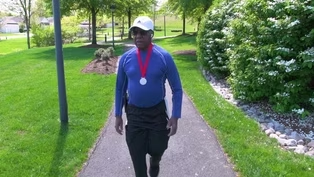
Clip: S2 Ep10 | 3m 39s | 81-year-old athlete Al Lamb says, “I want to win gold before I leave this world.” (3m 39s)

Addressing growing rates of Alzheimer’s disease
Video has Closed Captions
Clip: S2 Ep10 | 5m 4s | Alzheimer’s diagnoses are expected to increase in Virginia by 12% in 2025. (5m 4s)

Aging Well | People of Virginia
Video has Closed Captions
Clip: S2 Ep10 | 1m 13s | We asked the people of Virginia to share their thoughts on what it takes to age well. (1m 13s)

Baby boomers breaking the mold in retirement
Video has Closed Captions
Clip: S2 Ep10 | 1m 48s | The Baby Boomer generation faces retirement, but not all are ready to leave the workforce. (1m 48s)

Making connections after retirement
Video has Closed Captions
Clip: S2 Ep10 | 4m 2s | Keeping older adults active and connected as they age. (4m 2s)

Video has Closed Captions
Clip: S2 Ep10 | 3m 45s | The coronavirus still poses significant dangers, especially for older adults. (3m 45s)
Providing Support for PBS.org
Learn Moreabout PBS online sponsorship
- News and Public Affairs

Top journalists deliver compelling original analysis of the hour's headlines.

- News and Public Affairs

FRONTLINE is investigative journalism that questions, explains and changes our world.











Support for PBS provided by:
VPM News Focal Point is a local public television program presented by VPM
The Estate of Mrs. Ann Lee Saunders Brown